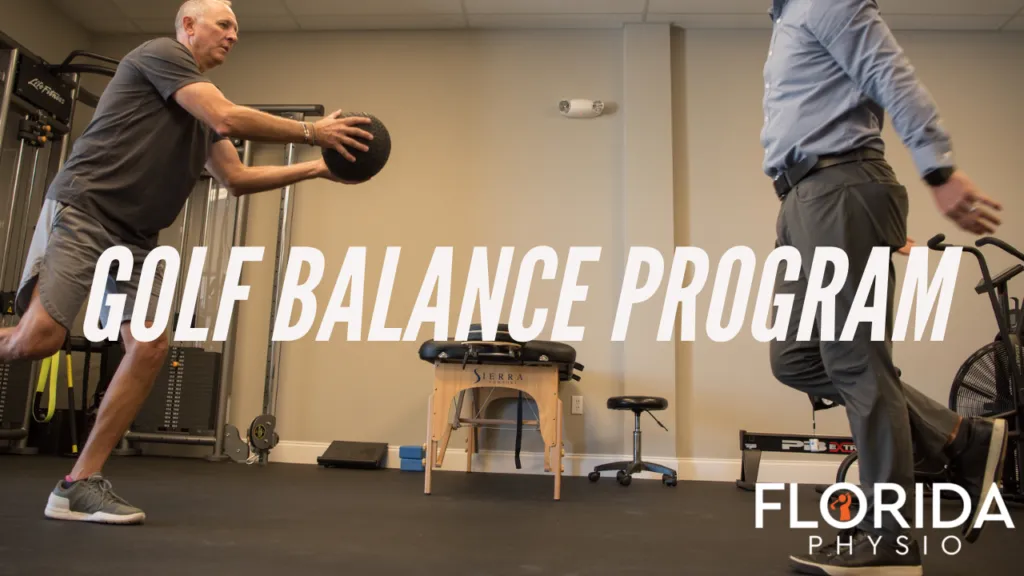
Have you ever watched a professional tournament or a high-level player hit balls on the range? One of the clearest things you’ll notice is the ability to swing at high speeds and then stick and hold the finish comfortably. Those players may swing 15–25 mph faster than the average amateur, yet they strike the ball and hold their finish with relative ease.
Reaching a maximized, balanced, athletic swing isn’t out of reach for amateur golfers. A golf swing is a high-speed, two-directional, torquing action that involves a significant weight shift while swinging a weighted club in a specific manner. Becoming a better player may therefore mean becoming a better athlete.
Balance Training Must Match the Sport
Postural awareness and strength create stability. Balance training can be just as important as mobility or power, but the work must be appropriately scaled and challenging.
Maintaining a single-leg stance for one minute may be less applicable to the swing than practicing full swings from a narrow base of support against resistance. Balance exercises need to be challenging and sport-specific for noticeable improvements.
Four Systems Help Us Maintain Balance
- Vision gives us information about where we are in space.
- The vestibular system in the inner ear detects gravity and provides more information about position.
- The somatosensory system detects pressure and stretch, helping us feel the ground and understand where the head is on the body.
- Strength gives us the framework to support ourselves despite external forces.
Physical therapists can identify whether someone is underusing or overusing any of these systems. Golf creates a unique challenge because the eyes remain fixed on the ball for most of the swing. Making sure the other systems are working well is critical for playing good golf over the long term.
Static and Dynamic Balance
Static balance is the ability to maintain a position despite conditions working against you. Dynamic balance is the ability to maintain continuity through a desired movement despite external forces.
In golf, static balance helps a player stay stable at setup in wind or on an uneven lie. Dynamic balance helps a player make an effective move on the ball despite the conditions of the shot. Sufficient dynamic balance is more important for making good, consistent golf swings.
Build Balance Into Golf Fitness
Sport-specific strength training that challenges dynamic balance is the most effective way to improve this aspect of golf fitness. Once learned, balance work should be incorporated into weekly maintenance and reassessed often, especially as strengthening and power blocks increase swing speed. More speed is much less effective without consistent stability.
Dr. Donald Wasoff, PT, DPT, TPI Certified